Warehouse and Inventory Management: Best Practices for Accurate, Efficient Stock Control

When orders are streaming in, forklifts are moving, pickers are weaving through the aisles, and the phones are buzzing with customer queries - it’s a typical start to a busy day for many warehouse and operations managers. “A good problem to have” is commonly heard when reflecting on the operational strain of ‘busy’ periods.
So, if you step back and look at the bigger picture of your business’ path of growth, that temporary ‘good problem’ can develop into ongoing pain points. When stock is hard to find or storage doesn’t make sense, every wasted minute shows up on the order log. Good warehouse and inventory management isn’t about counting every pallet - it’s about making sure everything has a place, teams can work without backtracking or bottlenecking, and stock moves through the building efficiently, however high your order intake.
For growing UK businesses, the warehouse is usually where the stress shows first. Orders pile up, stock moves slower, and small inefficiencies quickly ripple through operations. And it all comes back to this: is your space helping your operation run smoothly, or is it holding you back as your business grows?

What is warehouse and inventory management?
Warehouse and inventory management is the process of controlling stock from how goods are received, to where they are stored, how they’re picked, and how accurately everything is tracked.
At a practical level, it covers four main areas:
- Stock control – knowing exactly what SKUs and stock levels you have.
- Storage – how and where that stock is physically stored.
- Movement – how goods flow through the building
- Accuracy – how reliable your data is compared to reality
Many businesses use a Warehouse Management System (WMS) to support this, giving a real time view of stock levels and locations. A WMS can be powerful, but it only works properly if the physical space makes sense in tandem. If stock locations are unclearly marked, racking layout is inefficient, or access routes are congested, the system ends up reflecting poor processes rather than fixing them as it should.
In other words, warehouse management and inventory management are as much about space design as they are about software.
Objectives of warehouse and inventory management

Maintaining stock levels
On the face of it, inventory management keeps a balance between demand and what you have available. Add in the financial benefit of not tying too much cash up in inventory or minimising risk of your storage space becoming a constraint and it’s a dream process. This applies commonly for e-commerce and wholesale businesses where on-demand, fast fulfilment and readily available stock is crucial.
When stock levels are managed well, businesses can plan their purchasing with confidence, reduce emergency orders, and avoid paying for space they don’t actually need.
Improving order accuracy and fulfilment speeds
Picking speed and accuracy are closely linked to efficient warehouse layout. If stock is logically organised, clearly labelled and easy to access with the right equipment available, picking becomes faster and inaccuracies reduce naturally.
Poor layouts create inefficiencies that may not be obvious at first glance: extra walking distance for pickers, double handling, congested aisles and missed items. Over time, this can lead to slow fulfilment, frustrated teams and unhappy customers.
Reducing waste, loss & overstocking
If anything, lost, damaged or obsolete stock is often a symptom of poor storage design. When products are stored in unsuitable systems or squeezed into the wrong locations, visibility drops and control goes with it.
Effective warehouse and inventory management makes every item visible, accessible and accountable.
Core inventory management practices
Inventory classification and prioritisation
Not all stock deserves the same treatment. Top tip for any warehouse, particularly those in Third Party Logistics or for online retailers: high-volume, fast-moving items should be the easiest to reach. Slower movers can sit further back or higher up.
This is where storage systems become part of inventory strategy:
- Pallet racking for bulk or heavy items
- Medium duty shelving for cartons, components and pick faces
- Heavy duty shelving for heavy, hand-loaded products
Storing products on the right type of system, at the right height, in the right location reduces handling time and physical strain while improving picking accuracy.
Good classification also supports smarter space planning. Fast movers should be close to dispatch. Reserve stock can be further away. Specialist or awkward items should be kept in dedicated zones.
Cycle counting & inventory audits
Rather than disruptive annual stocktakes, cycle counting is when checks of small sections of inventory are carried out on a rolling basis. This keeps data up to date and accurate without stopping operations altogether.
Warehouses with racking layouts that suit their specific operation, consistent pick face labelling and clear storage logic find this much easier to maintain because staff always know where stock should be.
Inventory performance metrics
Useful metrics include:
- Stock accuracy
- Order fulfilment time
- Inventory turnover
- Storage utilisation
Beyond their use for reporting on KPIs, these factors show the true picture of whether your warehouse is genuinely supporting business performance or limiting it.
Storage systems for inventory management
This is where physical space becomes the main driver of performance - getting it right is crucial.
Pallet racking & structured stock locations
Pallet racking is still the backbone of most warehouses, and for good reason. It provides:
- Fixed, clearly defined stock locations
- Good visibility across SKUs
- Safer handling for heavy loads
- Support for FIFO stock rotation
When the right pallet racking solution is properly designed, installed and labelled, staff spend less time searching and more time moving stock. That directly improves order accuracy and picking speed.
The key isn’t just having racking, it’s having the right racking layout for your product profile and order flow.
Load management, weight limits and safety
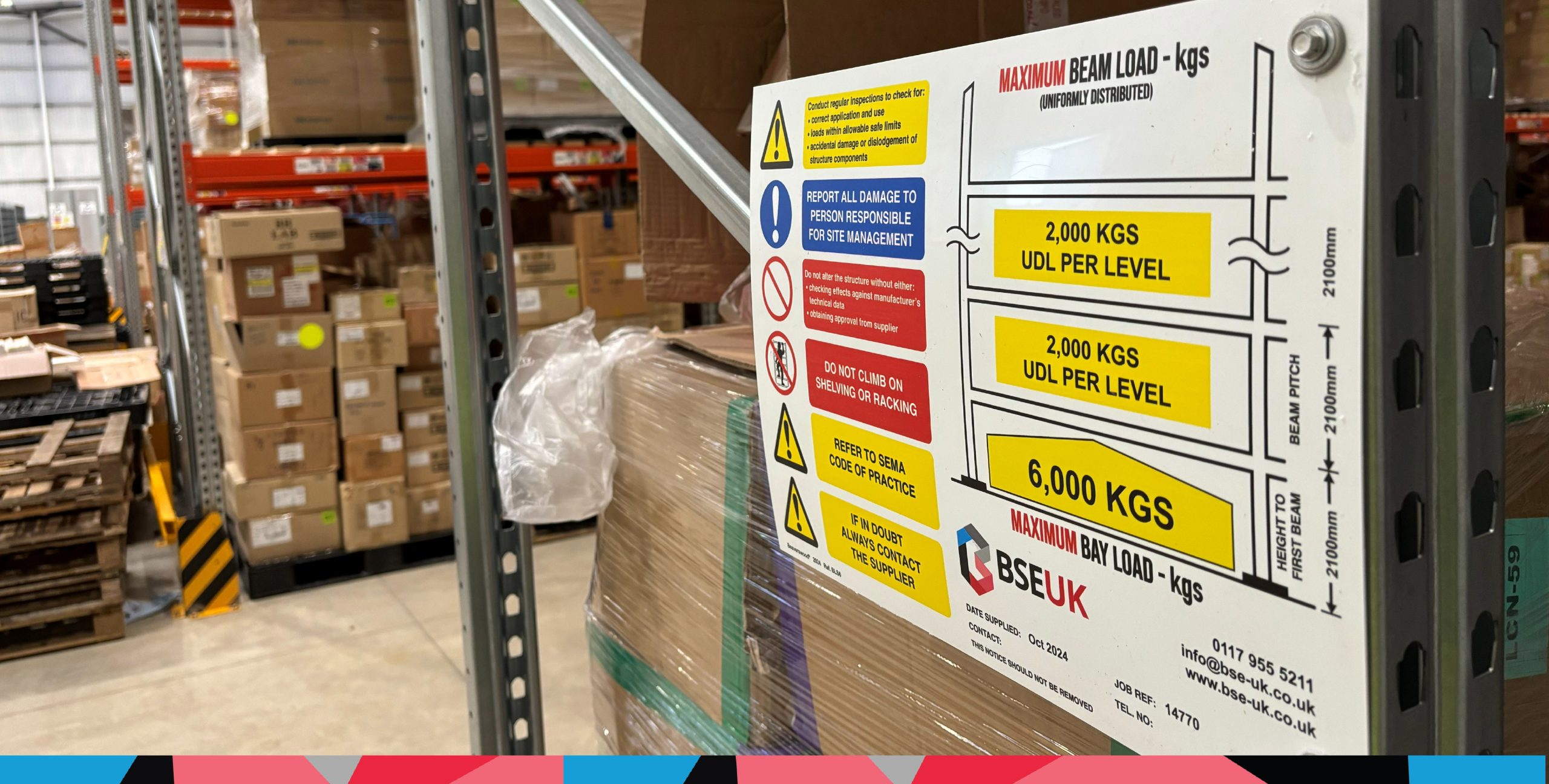
Every storage system has safe weight loading limits. Heavy duty shelving, pallet racking and mezzanine structures must all be installed with clear load signage and maintained through regular inspections both by an internal person responsible and by professional rack inspections on an annual basis.
Overloaded or damaged racking doesn’t just create safety risks. It leads to inaccessible stock, blocked locations and unreliable inventory data.
Using space efficiently for stock control
As businesses grow, the value of every inch of floor space goes up, so wasted space quickly becomes wasted time and money.
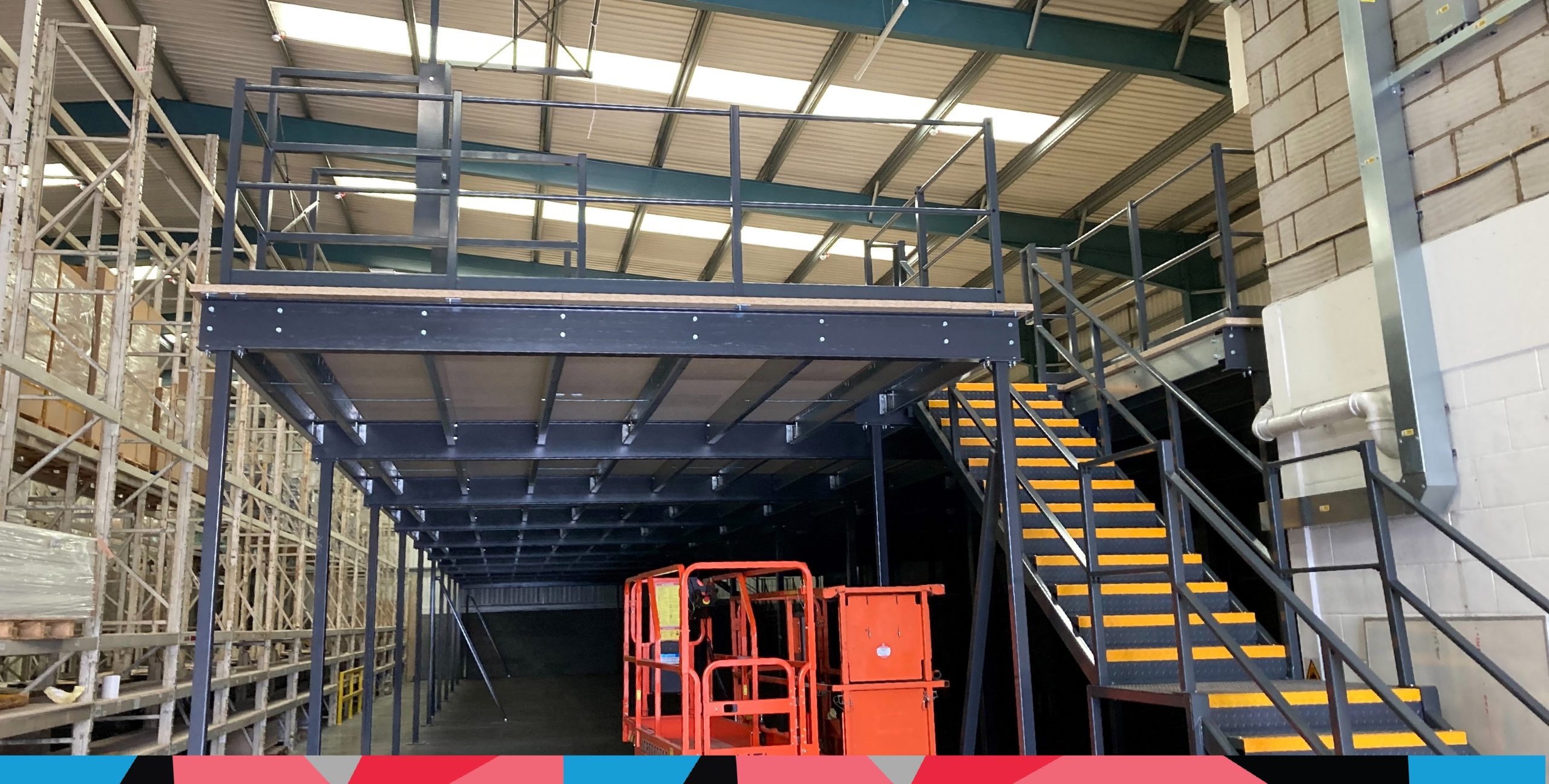
Mezzanine floors are one of the most effective ways to increase usable space without relocating. They’re often used for:
- Light storage
- Picking and packing areas
- Offices or quality control zones
Partitions also play a big role in inventory control. Separating fast moving stock from returns, quarantined goods, specialist items or high value items reduces congestion and keeps workflows clean.
Efficient use of space isn’t when you can squeeze more in. It’s about creating layouts that reduce friction between the three pillars of what keeps your operation moving: people, products and processes.
High-density and semi-automated storage systems
As operations scale, many businesses move beyond standard adjustable pallet racking to improve density, flow and throughput.
High-density manual systems include:
- Mobile pallet racking, where pallet racking bays are blocked together, and aisles move to open only where needed
- Drive-in and drive-through racking, for large volumes of the same SKU, perfect for LIFO operations.
- Very Narrow Aisle (VNA) racking, using specialist trucks to operate in tighter aisles for maximum capacity for direct access to 100% of stock.
These systems are still manual, but they significantly increase storage capacity without increasing the building footprint.
Semi-automated and fully automated systems come into play when throughput is high and consistency matters:
- Pallet shuttle systems
- Carton live and pallet flow racking
- Automated storage and retrieval systems (AS/RS)
- Automated Mobile Robots (AMR) that transport goods to pickers
These reduce manual handling, support faster picking and make stock movement more predictable, particularly useful for time-critical or high-volume operations.
For most growing businesses, the real decision isn’t about full automation. It’s about choosing the right balance between people, layout and technology.
Safety, compliance & maintenance
Why safe storage supports reliable inventory data management
Unsafe or poorly maintained storage leads to:
- Damaged stock
- Blocked access routes
- Unusable locations
- Inaccurate system data
Regular racking inspections by SEMA Approved Rack Inspectors, clear load signage and maintenance schedules protect both people and inventory.
Accurate inventory data depends on physical reality. If the storage isn’t safe or accessible, the numbers quickly become meaningless.
Practical guidance and tools
The UK Health and Safety Executive provides clear guidance on warehouse storage, racking inspections and safe working practices:
https://www.hse.gov.uk/pubns/books/hsg76.htm
Using inspection checklists, staff training and layout planning tools helps bridge the gap between warehouse design and day-to-day operations.

Keeping your inventory management practices up to date
Warehouse and inventory management isn’t a one-off project. It evolves as your business evolves.
Regular reviews help you:
- Adjust layouts as product ranges change
- Add mezzanines or new shelving as volumes grow
- Reconfigure racking for new order profiles
- Introduce higher-density systems when space tightens
The most effective warehouses don’t chase trends. They continuously align their space with real operational needs.
When your warehouse supports how your teams actually work, inventory management becomes simpler, more accurate, and far easier to scale.
Expert advice for your warehouse & inventory management
For expert advice on warehouse and inventory management, or to discuss your storage needs, get in touch with the team at BSE UK:
Call: 0117 955 5211
Email: [email protected]
Our team is ready to help you optimise your warehouse for accuracy, efficiency, and growth.
Signup to our newsletter below to receive all our latest news!
By submitting this form you agree to our privacy and data protection policy which governs how we deal with personal data.